

Home Upgrade Market Assessment Guide
Client: Federation of Canadian Municipalities (FCM) (https://fcm.ca/en)
Overview
Improving energy efficiency in existing homes is a major opportunity for municipalities to reduce greenhouse gas (GHG) emissions and support local climate goals. There are approximately 14 million homes in Canada¹, and residential energy use has increased by 11% since 2000. Buildings are often the second-largest source of community emissions after transportation, and the residential sector accounts for 13% of all end-use energy demand in Canada². Without energy efficiency improvements over that period, the increase would have been 43%³ — highlighting the value of continued investment in energy retrofits.
To support municipalities in launching effective home energy retrofit programs, the Canadian Government and FCM introduced the $300-million Community Efficiency Financing (CEF) initiative in 2020⁴. The initiative provides funding and resources to help municipalities implement programs that improve energy performance, comfort, and affordability in existing homes — while reducing emissions.
Project Description
A critical first step in developing a local retrofit program is understanding the market potential. Municipalities must consider questions such as: What are the overall size and characteristics of the local housing stock? Who would the program serve? What level of participation could be expected? And what potential emissions and energy savings could result?
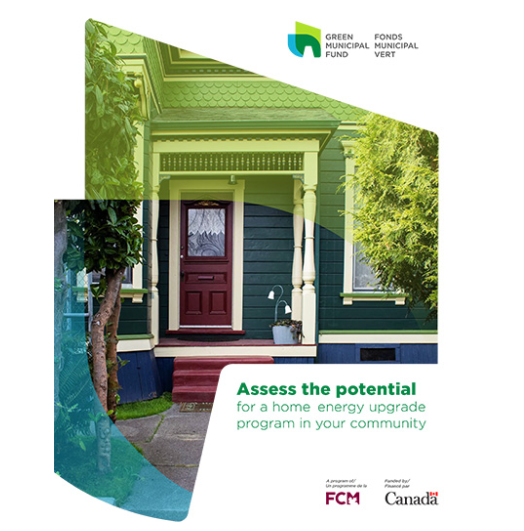
To assist municipalities with this process, Greenscale was engaged by FCM to lead the development of the Home Upgrade Market Assessment Guide (view the guide here). The guide supports municipal staff in evaluating their community’s retrofit potential, completing feasibility studies, and designing strong applications for CEF funding. It provides a structured, evidence-based approach to:
- Estimate program market size and expected participation
- Identify target homeowner segments
- Quantify expected emissions reductions and other benefits
- Build the business case for local investment
Municipalities across Canada are now using the guide to shape retrofit strategies and access CEF funding. One early example is the City of Kingston, which exceeded its four-year program target of 500 applicants within just 10 months — a strong demonstration of how planning tools can accelerate real-world implementation.
Greenscale helps municipalities turn climate goals into workable local programs by connecting high-level targets to on-the-ground realities. Our work draws on real housing stock data, participation estimates grounded in local conditions, and a clear understanding of CEF funding requirements. This approach supports municipal staff in designing retrofit programs that are both realistic and fundable — aligning climate planning with local capacity, timelines, and implementation pathways.
Sources
- Canada Energy Regulator. (2023). Provincial and territorial energy profiles – Canada. Retrieved from https://www.cer-rec.gc.ca/en/data-analysis/energy-markets/provincial-territorial-energy-profiles/provincial-territorial-energy-profiles-canada.html#s3
- Statista. (2023). Number of homes in Canada from 2001 to 2023. Retrieved from https://www.statista.com/statistics/1072334/number-of-homes-canada-timeline/
- Natural Resources Canada. (2023). Energy Fact Book 2022–2023 (Section 4). Retrieved from https://natural-resources.canada.ca/sites/nrcan/files/energy/energy_fact/2022-2023/PDF/Section_4_Energy-factbook-2022-2023_EN.pdf
- Federation of Canadian Municipalities. (2020). New initiative to help homeowners cut their energy bills and emissions. Retrieved from https://fcm.ca/en/news-media/news-release/gmf/new-initiative-to-help-homeowners-cut-their-energy-bills-and-emissions
 Greenscale